
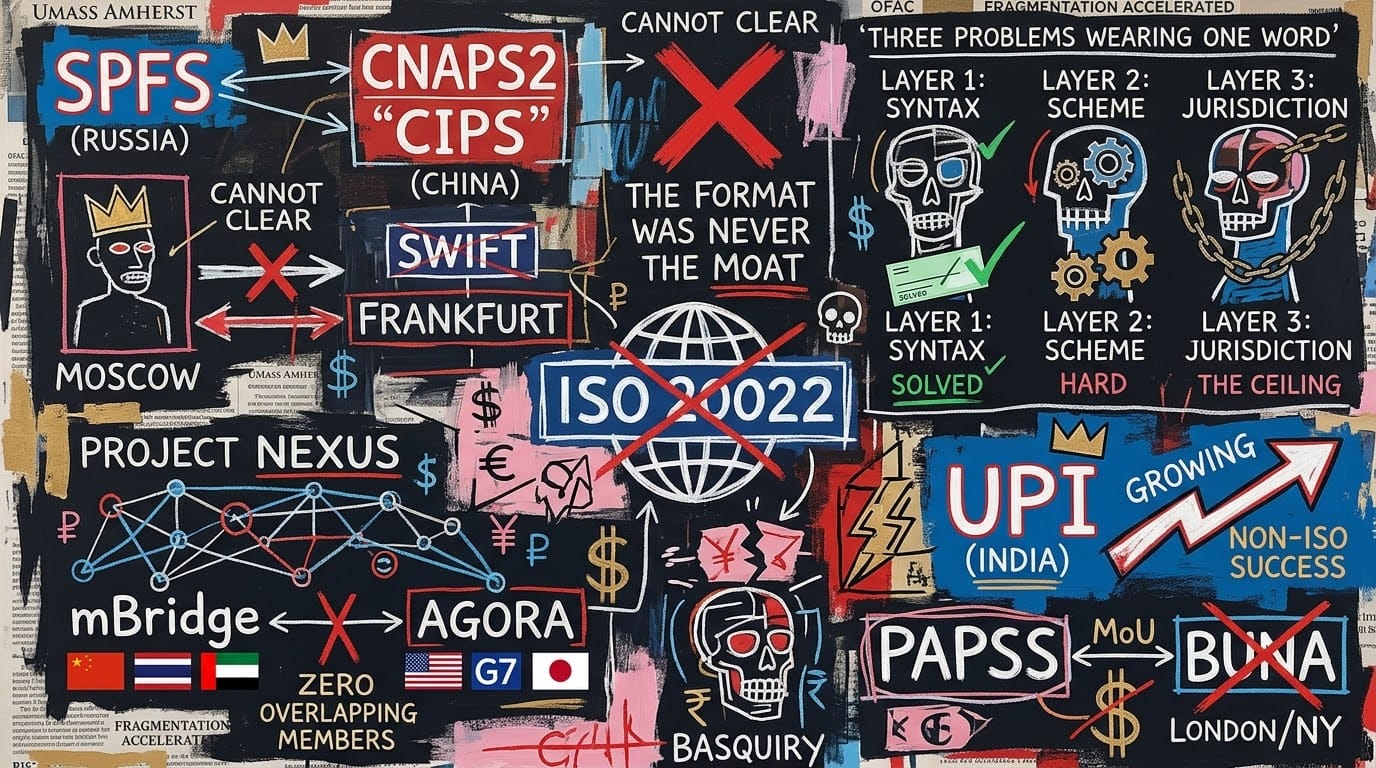
Here is a fact that should bother you more than it probably does. SPFS, the messaging system Russia built to survive expulsion from SWIFT, supports ISO 20022. The Bank of Russia says so on its own website, alongside SWIFT MT compatibility and a per-message price of less than two cents, posted like a menu, for any foreign bank that wants in.
Think about what that means. The system whose entire reason for existing is to route around Western financial infrastructure speaks Western financial infrastructure’s native language. If fragmentation were a format problem, SPFS would be the last place on earth you’d find the shared format. Instead it’s fully conversant. A payment instruction from Moscow can be parsed in Frankfurt without a single mapping table. It still won’t clear, and every payments professional reading this knows exactly why, even if our industry’s marketing does not.
We ran the experiment. The results are in.
For fifteen years, the pitch behind the great ISO 20022 migration was interoperability. Common language, common data model, frictionless corridors. The industry did its part. Look at the adoption map and notice whose names are on it:
- China published its migration plan in 2011 and had CNAPS2 live on ISO 20022 by 2013, years before most of the West. CIPS has run it since launch and has committed to the CPMI’s harmonised data requirements by end-2027.
- Russia supports it on SPFS, as above.
- Brazil built SPI, the settlement layer under Pix, on it natively.
- Europe runs it across SEPA, SCT Inst, and TIPS, which means Wero and iDEAL inherit it for free.
- Canada retired MT on Lynx in late 2025 and specified the Real-Time Rail on ISO 20022 end to end.
- Africa and the Gulf run it on PAPSS and Buna respectively.
- SWIFT itself completed CBPR+ in November 2025. MT is dead on cross-border. The migration everyone spent a decade dreading is finished.
Washington, Brussels, Beijing, Moscow, Brasília, Ottawa, Abu Dhabi, and a pan-African settlement system all landed on the same standard. By the industry’s own theory of change, corridors should be blooming everywhere. Count them. The trend line points the other way: more sovereign rails, fewer mutual clearing relationships, and a tariff threat aimed at Pix for the crime of being too successful.
A UMass Amherst working paper on CIPS makes the observation that should end the format conversation permanently. China openly aspires to set international standards, has forked plenty of them, and had every geopolitical incentive to fork this one. It didn’t. It adopted ISO 20022 enthusiastically and even accommodates legacy SWIFT messages. Beijing understood something a lot of interoperability vendors still don’t: the format was never the moat, so forking it would have cost compatibility and bought nothing.
And then there’s the exception that should really make you inquisitive. UPI, the largest instant payment system on the planet, does not use ISO 20022 at all. It runs NPCI’s own XML schema. India’s RTGS and NEFT speak the standard; the rail actually conquering cross-border retail does not. Keep that in mind for the next section, because UPI is about to embarrass the whole thesis.
“Interoperability” is three problems wearing one word
The word does too much work in our industry, and the ambiguity is profitable for people selling solutions to the wrong layer. Pull it apart and the fog clears:
Layer one: syntax. Can your system parse my instruction? Solved. Globally. This is the layer conference keynotes are still celebrating, roughly a decade after it stopped being the binding constraint.
Layer two: scheme. Who guarantees finality, who carries the FX, what happens to the recall, whose rulebook owns the dispute? Hard, contested, and genuinely tractable. This is where real engineering and real rulemaking are happening right now, and where careers in this industry should be pointed.
Layer three: jurisdiction. Who may join, who can be expelled, whose sanctions bind the transaction? Not tractable by anything running in a data center. This is the layer that actually severed Moscow from Frankfurt, and no schema on earth reconnects them.
Most fragmentation commentary, and most vendor pitches, quietly treat layer one as if it were the whole stack. The evidence says layer one has been solved for years while fragmentation accelerated. Whatever fragmentation is, it is not that.
Nexus: watch what the fix actually required
Project Nexus, out of the BIS Innovation Hub with the central banks of India, Malaysia, the Philippines, Singapore, and Thailand, is the most serious interlinking effort in production planning anywhere. It is also, read carefully, the best available confession of where the problem lives.
Every participant already had ISO 20022 available. Nexus still had to build: mandatory mappings from each domestic profile to Nexus-specific message requirements, covering not just the happy path but verification, status, exceptions, rejects, and returns; a scheme rulebook; per-participant implementation guides; an FX provider layer; and an entire managing entity, the Nexus Scheme Organisation, incorporated in Singapore to own the rules. The CPMI states the reason with unusual bluntness: without common standards and usage guidelines, every interlinking arrangement grows a bespoke integration anyway. Shared syntax without shared semantics and shared governance produces exactly nothing.
The same CPMI paper then quietly names the ceiling. OFAC rules, it notes, are applied worldwide in practice while remaining US-originated standards with no legal standing anywhere they haven’t been transposed into domestic law. Read that sentence twice. The BIS, the least dramatic institution in finance, is telling you that the binding constraint on global payment connectivity is one country’s administrative law operating extraterritorially through risk departments. That is layer three, and there is no pacs.008 for it.
The alliances give the game away
If fragmentation were technical, coalitions would form around compatibility. Watch where they actually form.
In 2024 the BIS walked away from mBridge, handing it to the central banks of China, Hong Kong, Thailand, the UAE, and Saudi Arabia, while Agustín Carstens insisted, categorically, that “mBridge is not the BRICS Bridge.” The same year, BIS launched Project Agorá with seven G7-aligned central banks and forty-plus institutions including JPMorgan, Citi, HSBC, and SWIFT. Two projects. One problem. Zero overlapping members. Roughly 95 percent of mBridge volume settles in digital yuan. You do not need a political science degree to read that map, just a membership list.
Meanwhile India is quietly winning with the least ideological strategy on the board. NPCI International has stood up UPI corridors to Singapore, the UAE, France, Bhutan, Nepal, Sri Lanka, and Mauritius, targeting ten-plus by end of 2026. Cross-border UPI volume went from roughly 37,000 transactions in FY24 to over 755,000 in FY25. Bilateral deals, negotiated one government pair at a time, on a rail that does not speak the shared standard. The non-ISO system is out-connecting the ISO world because India is solving layers two and three corridor by corridor and treating layer one as an implementation detail, which is what it is. That is as close to a controlled experiment as this industry will ever run, and the interoperability thesis lost.
PAPSS tells the same story in economic terms. Before it existed, two African banks settled with each other through correspondent accounts in London or New York, in dollars or euros, at a continental cost AfCFTA puts near five billion dollars a year. Nothing about that flow was technically necessary. It was a jurisdiction and liquidity arrangement, and it took a treaty framework, Afreximbank’s balance sheet, and daily net settlement across central banks at 11:00 UTC to replace it. PAPSS and Buna, both ISO 20022 native, still needed an MoU to connect to each other. The standard bought them a shared dictionary. The MoU bought them a relationship. Only one of those moves money.
The test I’d apply to every pitch, including mine
I’ve spent a large part of my career on payment platform architecture, including patent work on event-driven, choreographed settlement across domains that could not be placed under one coordinator. I believe in that work. I also think it does not solve this problem, and the discipline of saying so is exactly what’s missing from most of what gets published in this space.
Decentralized settlement designs remove the central coordinator, but they do not remove the agreement. Somebody’s event semantics, somebody’s finality conditions, somebody’s admission rules. The agreement is the trust decision, and relocating it from “whose orchestrator” to “whose schema” changes nothing when the parties are sovereigns who have specifically decided not to accept each other’s authority over settlement. Choreography answers organizational distrust inside a firm. It does not answer sovereign distrust between states, and the difference is in kind, not in scale.
So here is the test, and it works on vendors, keynotes, and white papers alike. Ask what the proposed layer accomplishes that a message standard already adopted by Washington, Brussels, Beijing, Moscow, Brasília, Ottawa, and the Arab Monetary Fund failed to accomplish. If the honest answer is rulebooks, liquidity, and jurisdiction, then the work is legal and diplomatic with an engineering component, not the reverse, and it should be staffed, priced, and sold that way. If the answer is another schema, you are watching someone solve 2011’s problem with 2026’s budget.
Sources
- Bank of Russia, Financial Messaging System of the Bank of Russia (SPFS)
- CIPS, ISO 20022 standards page
- Payments Canada, ISO 20022 resources
- BIS, Project Nexus and CPMI, Enhancing Cross-Border Payments: Fast Payment System Interlinking
- PAPSS, How it works
- World Bank, Messaging Standards in Fast Payments
- PERI, University of Massachusetts Amherst, working paper on CIPS
- The Economist, “Storm clouds gather over America’s financial supremacy”, July 12, 2026