Every enterprise AI transformation has a dashboard. That dashboard has a number. And that number almost always measures the wrong thing.
When leadership asks “Are we adopting AI?”, the organization responds with what it can count: licenses provisioned, sprints completed, models deployed, prompt libraries published. The Agreement Axis : the visible, measurable dimension of organizational alignment dominates every steering committee deck. People are nodding. People are using the tools. The status is green.
But the project is dying.
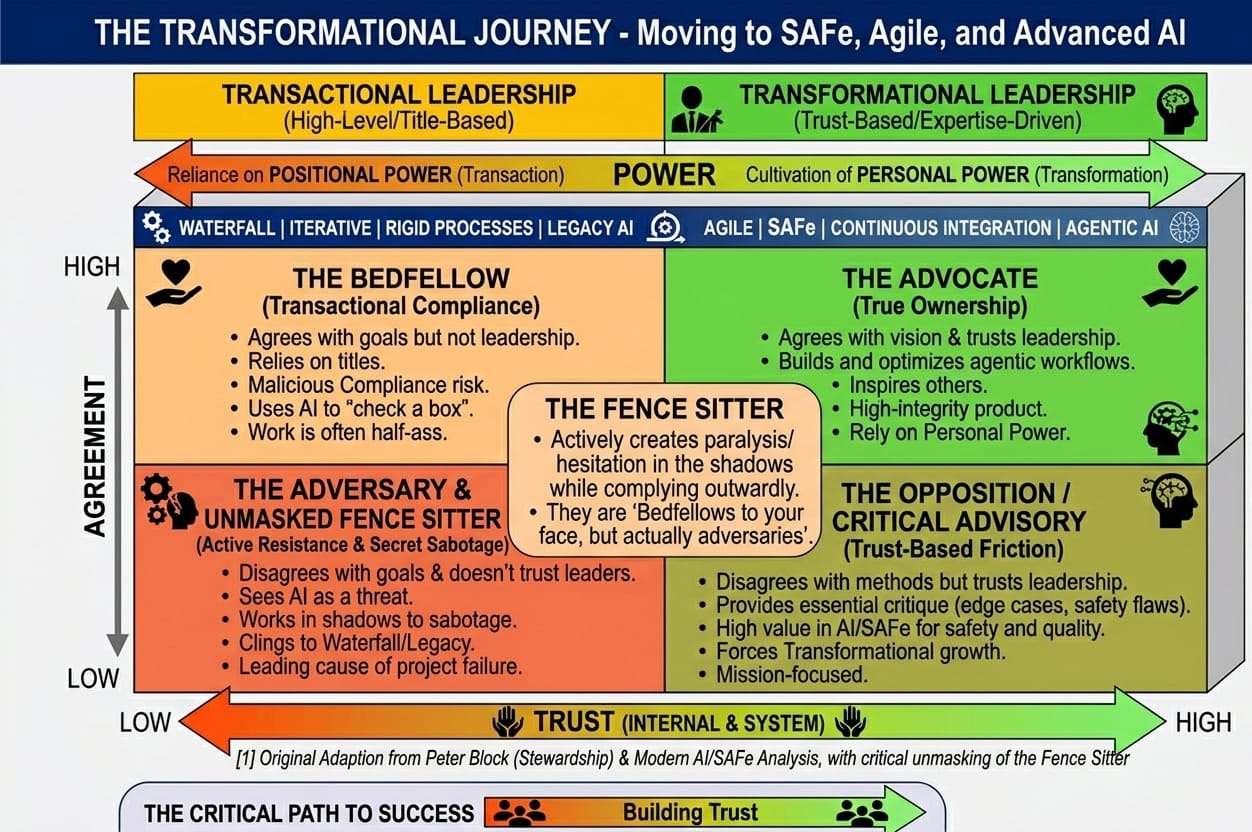
The diagram below is an adaptation of Peter Block’s stewardship model, extended for the modern AI/SAFe transformation reveals why. It introduces a second axis that most leaders ignore until it’s too late: Trust.

The Two Axes Every Leader Must Read
Block’s original model mapped organizational behavior against two dimensions: how much someone agrees with the mission, and how much they trust the leadership driving it. The combination produces four quadrants and five archetypes but the real insight is in the fifth, the one lurking in the center of the matrix.
The vertical axis — Agreement : is what transactional leaders optimize. Do you support the initiative? Are you using the mandated LLM? Did you attend the SAFe training? High agreement is easy to manufacture when you control incentives. It says nothing about conviction.
The horizontal axis — Trust : is harder to see, harder to build, and impossible to fake. It measures whether people believe the leader has earned the right to lead this change, not through title, but through demonstrated expertise, empathy, and integrity. This is the axis that separates organizations that adopt AI from organizations that are transformed by it.
The Masked Adversary Problem
Here is where the model becomes dangerous and useful.
When a leader relies on Positional Power (the left side of the matrix), they create a transactional environment. Agreement is purchased with paychecks, enforced with performance reviews, and validated with compliance metrics. In this zone, the organization produces a specific archetype at an alarming rate: The Bedfellow.
Bedfellows occupy the upper-left quadrant. They agree with the stated goals but do not trust the leadership behind them. They rely on titles, not conviction. They use AI to “check a box.” Their work product is, to use Block’s unflinching term, often half-hearted. They are organizational mercenaries, and a transactional leader will staff an entire transformation with them without knowing it.
But the real threat is worse than the Bedfellow. It is the figure sitting in the dead center of the matrix.
The Fence Sitter is the most dangerous archetype in any AI transformation. They actively create paralysis and hesitation in the shadows while complying outwardly. To a transactional leader measuring agreement, they look like Bedfellows: nodding, attending, delivering status updates. But because trust is absent, they are actually adversaries in disguise.
They won’t flag a hallucinating model. They won’t challenge a broken sprint process. They won’t tell you the architecture is unsound. Not because they don’t see it, but because they don’t feel safe enough to own the outcome.
This is the mechanical failure of transactional leadership laid bare. When you optimize the Agreement Axis through positional authority, you do not create alignment, you create a masking layer. The Fence Sitter is Bedfellow to your face and Adversary behind closed doors. Your dashboards stay green while your initiative rots from the inside.
The Right Side of the Matrix
The solution is not more agreement. It is more trust. And building trust requires a fundamentally different kind of leadership, one that moves the entire organization to the right side of the matrix.
Shift from Positional Power to Personal Power
Transformational leaders do not rely on their title to drive change. They rely on Personal Power, the authority earned through deep expertise, consistent empathy, and visible integrity. When a leader demonstrates that they understand the technology at an architectural level, that they grasp the human cost of the transition, and that they will absorb risk alongside their teams, the need for masks evaporates. People stop hiding their resistance because resistance is no longer punished. It is channeled.
Unmask the Fence Sitter by Making Dissent Safe
The Fence Sitter exists because silence is safer than honesty. In a transactional culture, raising a red flag is a career risk, so people don’t. They produce compliant mediocrity and let the system fail on its own schedule. The only way to unmask them is to make the cost of honesty lower than the cost of silence. This is not a cultural slogan. It is a structural design problem: blameless retrospectives, architectural review boards with real authority, and leaders who visibly reward the person who killed the “green” status report in favor of an honest “red” one.
Embrace the Opposition as Your Critical Advisory
On the right side of the matrix, in the lower-right quadrant, lives an archetype that transactional leaders instinctively suppress: The Opposition. These are people who disagree with your methods but trust your leadership. In a transactional world, they are labeled troublemakers. In a transformational world, they are your most valuable asset.
The Opposition provides high-integrity friction. Because they trust the leader, they feel safe enough to disagre and their disagreement catches edge cases, safety flaws, and architectural weaknesses that a room full of Bedfellows would let slide. They are mission-loyal, not manager-loyal. In an AI transformation, where a single unchallenged hallucination or a poorly governed model can create enterprise-scale risk this is exactly the voice you cannot afford to silence.
And in the upper-right quadrant: The Advocate. High agreement, high trust. These are the people who don’t just adopt the new tools, they build and optimize agentic workflows, inspire their peers, and produce high-integrity work product because their commitment is to the mission, not to the appearance of compliance. Advocates are not born. They are the natural result of transformational leadership operating on both axes simultaneously.
The Architect’s Takeaway
If you are leading a move to Agentic AI, SAFe, or any transformation that demands genuine behavioral change from your organization, your primary job is not technical orchestration. It is trust orchestration.
If you lead by transaction, you will be surrounded by masked adversaries who will watch your project fail without saying a word. If you lead by transformation, you will build a team of Advocates who drive innovation and Opposition who keep that innovation safe.
The work product is only as good as the trust behind it. Stop measuring agreement. Start building the conditions required for honest disagreement. The critical path to success, the arrow at the bottom of the model runs in one direction: from positional power toward personal power, from compliance toward conviction, from transaction toward trust.
That path does not show up on your dashboard. But it is the only one that leads somewhere real.
Understanding the importance of AI transformation leadership trust is crucial for navigating these challenges effectively.
Building a culture centered around AI transformation leadership trust fosters innovation and resilience within your teams.
In the landscape of organizational change, understanding the dynamics of AI transformation leadership trust is essential for cultivating effective collaboration.