There is an unspoken rule in the modern enterprise: when the market moves, you move with it.
Right now, that movement is an aggressive, uniform march toward AI-driven structural restructuring. Across tech and finance ecosystems, executives are leveraging new automation toolsets to collapse traditional organizational boundaries, compress cross-functional roles, and strip down operational headcount. In early 2026, Block cut roughly 40 percent of its workforce and named AI as the reason. The market rewarded it: the stock surged. The prevailing consensus is clear. To remain competitive, one must be as lean, automated, and algorithmic as possible.
But a critical distinction is being lost in the noise: the difference between optimization and strategy.
A key consideration in this context is the relationship between AI strategy vs operational effectiveness, which can significantly impact decision-making processes and outcomes.
When an executive team defaults to copying a market trend simply because everyone else is doing it, they are not executing a strategy. They are participating in a herd mentality that systematically erodes their unique competitive advantage. True executive leadership requires the analytical acuity to understand exactly where the market is going, and the distinct courage to set a contrary North Star based on what actually makes your specific business thrive.
The Red Queen Trap of Modern Tech Hype
To understand why chasing market trends is a losing game, look to evolutionary biology and a concept with three decades of empirical support in strategic management research: the Red Queen Effect.
Taken from Lewis Carroll’s Through the Looking-Glass, the Red Queen tells Alice:
“Now, here, you see, it takes all the running you can do, to keep in the same place. If you want to get somewhere else, you must run at least twice as fast as that!”
“Now, here, you see, it takes all the running you can do, to keep in the same place. If you want to get somewhere else, you must run at least twice as fast as that!”
This is not a business-school metaphor stretched past its limits. Barnett and Hansen formalized Red Queen dynamics in organizational evolution in 1996, and a subsequent multi-industry study of more than 4,700 competitive actions confirmed the mechanism: a firm’s competitive moves improve its performance, but they also increase the number and speed of rival responses, which then erode the original firm’s gains. Everyone runs faster. Relative position holds. Margins compress.
[Competitor A Automates Role] ──> [Competitor B Matches It] ──> [Baseline Margin Drops]
         ▲                                                               │
         └────────────────── [New Standard Dictates Next Cut] ◄──────────┘
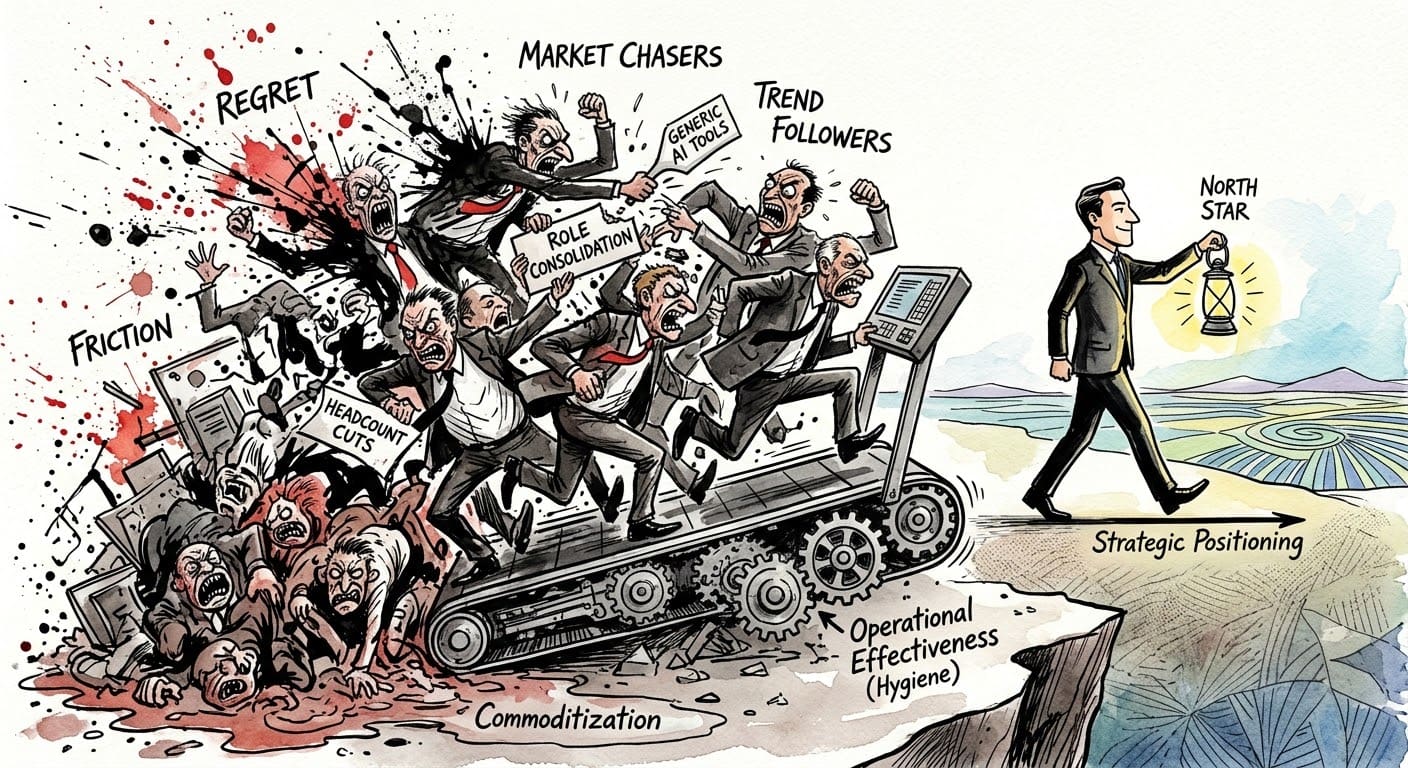
The executive rush to use AI to collapse traditional engineering, middle-management, and operational roles is a textbook Red Queen trap. When you compress your organization’s roles simply because the market is doing it, you are not gaining a first-mover advantage. You are paying the baseline cost of admission to stay in the exact same place. Because your competitors are accessing the same foundational models and automation APIs, generic efficiency gains are rapidly matched.
The honest caveat: not everything is instantly copied. Fast movers can accumulate proprietary training data and workflow context that laggards cannot buy off the shelf. But notice what that concedes. The defensible asset is not the generic tool or the headcount cut. It is the proprietary integration of the tool with your specific data, processes, and people. That is a positioning choice, which is exactly the point this article is making.
The empirical scoreboard on blind adoption is now in, and it is brutal. MIT’s GenAI Divide report found that roughly 95 percent of enterprise AI pilots delivered no measurable P&L impact despite tens of billions in investment, with researchers attributing the failures to flawed integration rather than model quality. The methodology has its critics, so treat the number as directional. But the workforce data is harder to argue with. Forrester reports that 55 percent of employers already regret laying off workers for AI, and Gartner predicts that by 2027, half of the companies that attributed headcount reductions to AI will rehire for similar functions, often under different job titles.
Klarna lived the full cycle in public. It replaced roughly 700 customer service roles with an AI assistant, watched satisfaction fall and complaints climb, and reversed course, with its CEO admitting the company focused too much on efficiency and cost, and now positioning human support as a competitive advantage rather than a cost center. Read that last clause again. The reversal did not restore the status quo. It converted the human capability the trend said to eliminate into the differentiator.
The result of trend-following restructuring: you have disrupted your internal culture, severed vital institutional knowledge, and accelerated organizational friction, all to achieve a temporary margin bump your rivals match next quarter. You are running as fast as you can on a treadmill designed by someone else.
Porter’s Antidote: Operational Effectiveness vs. Strategy
Harvard Business School professor Michael Porter offered the definitive escape from the Red Queen trap nearly thirty years ago in “What Is Strategy?” by drawing a sharp line between Operational Effectiveness and Strategic Positioning.
Operational Effectiveness means performing similar activities better or faster than your rivals. Adopting generic AI tools to automate back-office workflows is an optimization of OE. It is a necessary hygiene factor, but because it is highly imitable, it cannot yield a sustainable advantage.
Strategic Positioning, conversely, is about deliberately choosing a different set of activities to deliver a unique mix of value.
When every organization looks at the same trend reports and applies the same automation playbooks to collapse the same traditional roles, they trigger what Porter calls competitive convergence. They commoditize their own operating models. If your team structures, your engineering guardrails, and your execution layers look identical to your competitors, you have surrendered your differentiation. You have entered a race to the bottom where the only differentiator left is price.
Designing Intentional Non-Conformity
Escaping the Red Queen requires an unshakeable understanding of your company’s proprietary value chain. If your business model thrives on nuanced client advisory, deep relationship equity, or highly contextualized engineering solutions, then aggressively collapsing those human elements to hit an arbitrary automated baseline is a net-negative trade-off.
To protect your strategic positioning, look at the market through a lens of curated integration rather than blanket adoption:
1. Decouple Your Core Value from Market Tooling
Technology should optimize your activities, not redefine your identity. A sound corporate strategy uses automation to handle generic, low-leverage processes, improving baseline OE, while deliberately shielding and investing in the unique human structures that generate your proprietary alpha. The MIT data supports this allocation: the pilots that succeeded were tightly scoped, domain-specific, and pointed at back-office operations rather than headline-grabbing transformation programs.
2. Capitalize on the Market Vacuum
When the entire market pivots to low-touch, highly automated interactions, a stark strategic opportunity emerges. The market creates a vacuum. By maintaining robust, highly specialized, human-anchored roles, your intentional non-conformity becomes a premium, defensible market differentiator. This is not speculation. It is the position Klarna retreated to after the trend failed, except the anti-trend executive arrives there by design rather than by reversal, without paying the rehiring costs, the reputational tax, or the two lost years.
3. Anchor to Contextual Realities
The market operates on averages; your business operates on specifics. A market trend cannot factor in your team’s culture, your clients’ idiosyncratic preferences, or the long-term institutional knowledge built into your current roles. Your North Star must be calibrated to your specific circumstances, not an aggregated industry report.
The Executive Verdict
It is easy to manage a company by clipboard: checking off the trends, adopting the consensus frameworks, and cutting roles to align with industry buzzwords. If the company underperforms, a weak leader can hide behind the defense of “we followed standard market protocol.” The data now shows where that defense leads. A majority of the executives who cut for AI regret it, and half will be quietly rehiring the roles by 2027.
Real executive leadership is an act of calculated defiance. It requires you to look directly at a massive technological wave, deeply understand its mechanics, and have the clarity of vision to say: “We see where the industry is running, but this is how we win.”
Stop adjusting your sails to chase every transient market gust. Fix your eyes on your proprietary North Star, design a unique architecture that serves it, and let the market try to catch up to you.