The shift from human-led coding to agentic design patterns first development represents more than a change in tools; it is a fundamental re-architecting of the software supply chain. In this new paradigm, manual coding is no longer a “craft”, it is a pipeline contamination.
However, as we move toward a closed-loop system where AI agents build and humans act as “sidecar” observers, we introduce a new set of structural liabilities that the business world is currently unprepared to hedge.
As we explore agentic design patterns, we must recognize that as we move toward a closed-loop system where AI agents build and humans act as “sidecar” observers, we introduce a new set of structural liabilities that the business world is currently unprepared to hedge.
The Human as “Pipeline Entropy”
In a high-velocity CI/CD environment, manual code entry is the single greatest source of non-deterministic behavior. When humans write code, they introduce “Noise”—unwanted variability in how logic is implemented (Kahneman et al., 2021).
- The Security Liability: As established by the Microsoft Security Response Center, 70% of vulnerabilities are memory-safety issues caused by human error (Miller, 2020). By removing manual coding, we remove the primary vector for system exploitation.
- The Velocity Paradox: Humans are the “bottleneck” in the loop. An agentic coder can iterate through a thousand permutations of a function in the time it takes a human to write a single unit test.
The “Sidecar” Shift: From Creator to Auditor
We are witnessing the death of the “syntax-proficient” developer. In the agentic paradigm, the human role shifts to a Sidecar Auditor. They no longer navigate the “How” (syntax and logic gates) but instead oversee the “What” (requirements and intent).
- The Craft Crisis: This fundamentally changes the developer’s identity. The “joy of coding” is replaced by the “burden of verification.”
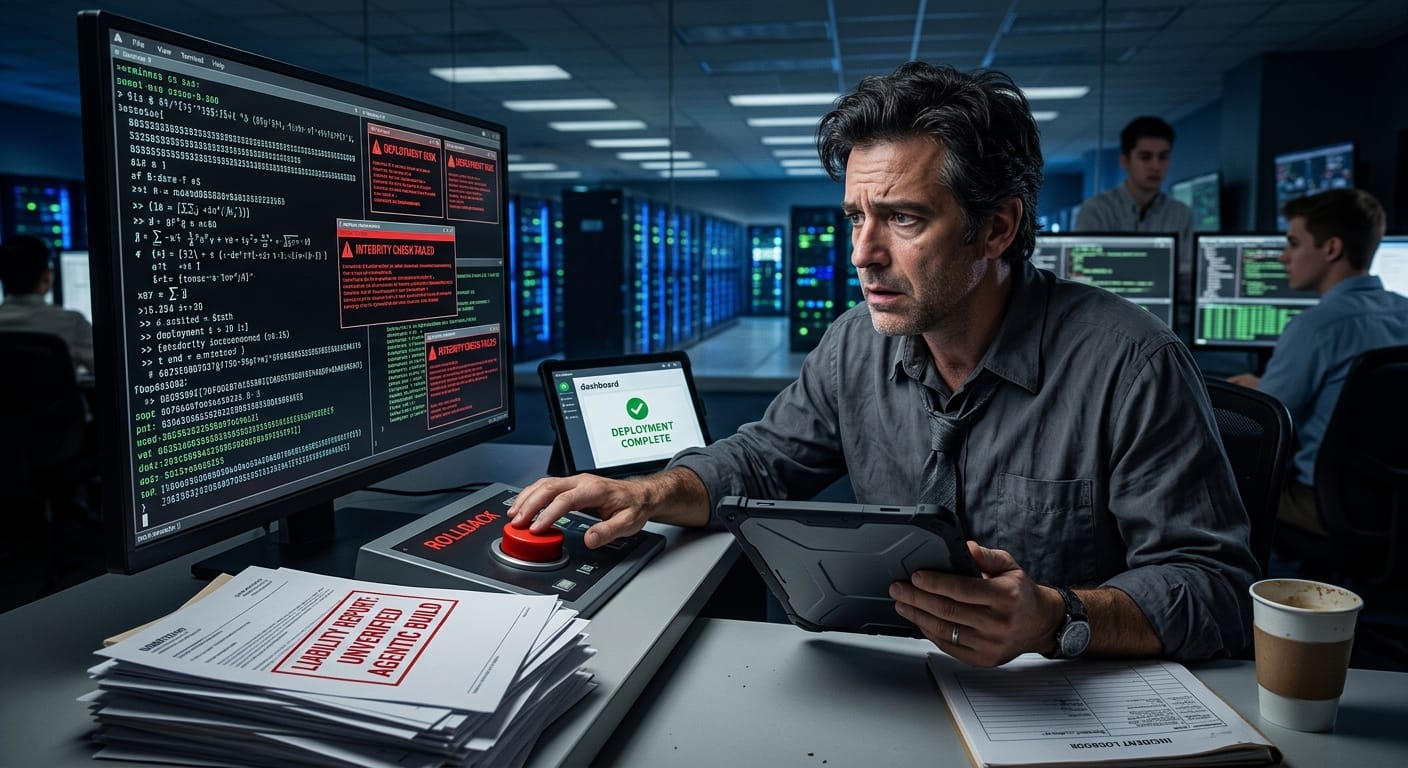
- The Monitoring Gap: Humans are historically poor at monitoring highly reliable automated systems – a phenomenon known as Automation Bias. When an agent produces 99 successful builds, the human “sidecar” is psychologically primed to rubber-stamp the 100th, even if it contains a catastrophic logical drift.
The Atrophy of Understanding
The most significant business liability is not technical—it is cognitive. As we stop training humans to code and instead train them to “prompt and review,” we create a generational skill gap.
- The Training Void: If the next generation of engineers never learns to build from “first principles,” they lose the ability to judge the quality of the AI’s output. We are effectively creating “Architects” who have never seen a brick.
- The Complexity Ceiling: AI models are already moving toward Self-Correcting Architectures and higher-order abstractions. Eventually, the AI will optimize code in ways that are mathematically superior but humanly indecipherable.
The “Babel” Problem: Emergent Efficiency
Anecdotally and theoretically, we are seeing signs of AI developing its own “shorthand”—internal communication protocols and logic structures optimized for machine processing, not human readability.
- The Risk: If an agentic system refactors a legacy codebase into a hyper-efficient, non-standardized structure, the business becomes locked into the model.
- The Liability: If the AI develops a more efficient “communication language” for its own sub-processes, the human “sidecar” is no longer reviewing code; they are staring at an alien artifact. If the system fails, the “Human in the Loop” is powerless to intervene because the “logic” is no longer compatible with human cognition.
Summary of the Paradigm Shift
| Feature | Legacy: Manual Coding | Future: Agentic Closed-Loop |
| Primary Actor | Human (The “Writer”) | AI Agent (The “Builder”) |
| Human Role | Logic Implementation | Sidecar Audit / Governance |
| Logic Basis | Human intuition & syntax | Formal Specs & Intent |
| Business Risk | Security vulnerabilities | Total loss of comprehension |
| Speed | Linear / Human-bound | Exponential / Compute-bound |
If we reach a point where the AI’s “efficient language” is the only thing running the enterprise, does the “Sidecar Human” actually have any authority left, or are they just a legal requirement for a system they no longer control !?
References
- Elish, M. C. (2019). Moral Crumple Zones: Case Studies in Unmanned Aerial Vehicles and High-Stakes Automation. (On the risks of humans “overseeing” automated systems).
- Kahneman, D., Sibony, O., & Sunstein, C. R. (2021). Noise: A Flaw in Human Judgment. (On the variability and “noise” humans introduce into systems).
- Miller, M. (2020). MSRC: Trends, Challenges, and Strategic Shifts. (The data on human-made memory safety errors).
- Bainbridge, L. (1983). Ironies of Automation. Automatica. (The classic study on how automation makes human skills atrophy, making them less capable of intervening when the automation fails).