
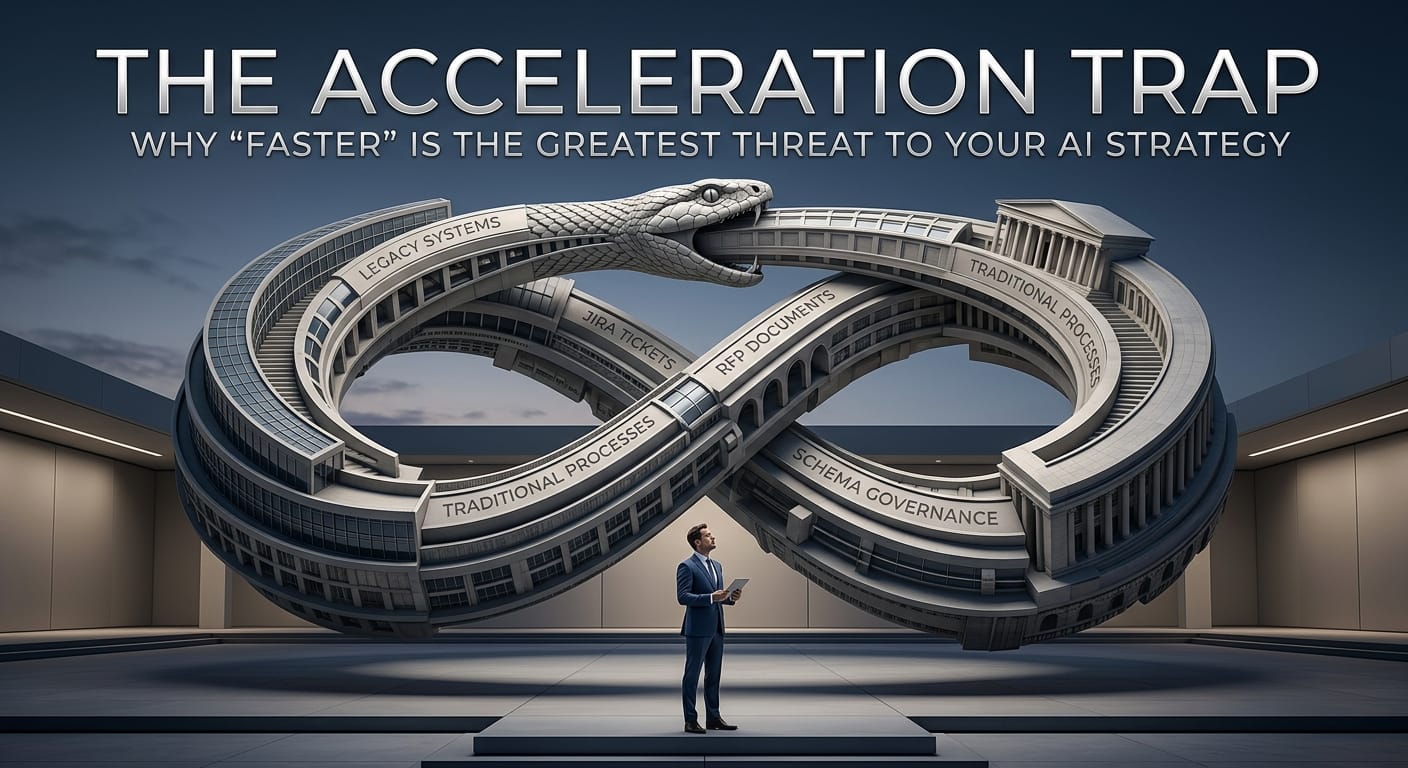
There is a quiet tragedy unfolding in the modern boardroom. It is the belief that if we use Artificial Intelligence to make our existing processes move faster, we are winning the race.
As a leader, it is easy to celebrate the “quick wins.” We see developers building agents that automatically triage Jira tickets. We see architects using LLMs to “automagically” generate complex ArchiMate diagrams from natural language. We see procurement teams using AI to draft RFP responses in minutes rather than months. To the traditional executive, this looks like a digital transformation masterclass.
It isn’t. It is a speed trap.
By leveraging AI against our traditional processes, we are simply becoming faster at doing things that shouldn’t be done at all. We are building the world’s most efficient steam engine in an era of jet propulsion. The real prize isn’t “AI-Accelerated Legacy”; it is the Paradigm Shift—reimagining the enterprise to work with AI, rather than forcing AI to work for the enterprise.
1. The Jira Delusion: Automating the Artifact, Not the Outcome
The “Jira Ticket” is a human-centric coordination artifact. It exists because humans are forgetful, need synchronous alignment, and require a paper trail for accountability.
2. The Diagram Paradox: Drawing the Past in High Definition
We have traditionally viewed the “Enterprise Architecture Diagram” as the source of truth. It is the map of our kingdom. Executives love these diagrams because they provide a sense of control over complexity.
3. The RFP Cycle: Building the Bureaucratic Ouroboros
The Request for Proposal (RFP) is perhaps the ultimate symbol of traditional enterprise friction. It is a document-heavy process designed to mitigate risk through exhaustive questioning.
4. The Determinism Fallacy: Caging the Probabilistic Beast
Perhaps the most common mistake in the C-suite is the desire to “control” LLMs using rigid agentic frameworks. Leaders are terrified of the “probabilistic” nature of AI—the fact that it might give a different answer twice.
The “Skeuomorphic” Cost of Waiting
In the early days of the iPad, many apps were designed to look like physical leather-bound notebooks, complete with “torn paper” edges. This is called skeuomorphism—making the new look like the old to make it less scary.
Your current AI strategy is likely skeuomorphic. You are trying to make a world-changing intelligence look like a Jira ticket, a Visio diagram, or a PDF report.
But there is a cost to this comfort. Every dollar you spend building “around” your traditional processes to make them go faster is hidden technical debt. When the paradigm shift eventually forces you to abandon those processes entirely, all that “AI-accelerated” tooling will have to be ripped out.
The C-Suite Challenge
To lead in the AI era, you must stop asking: “How can AI make this process faster?” Instead, you must ask:
The goal of a modern AI strategy shouldn’t be acceleration—it should be obliteration. Remove the friction, the static documentation, and the manual hand-offs. The enterprises that move beyond the “faster version of the past” are the ones that will actually own the future.
Don’t be the executive who celebrates the fastest horse-drawn carriage in history just as the first car drives past you. Stop building for the artifacts of the past and start bracing for the impact of a borderless, autonomous, and intent-driven future.
Embracing Enterprise payment orchestration is essential for organizations looking to streamline their financial processes and enhance efficiency.