In a world where market shifts happen in heartbeats, the traditional corporate “pyramid” is starting to look more like a relic than a command center. To survive, modern firms are looking toward a different biological inspiration: the cephalopod.
Becoming an Octopus Organization isn’t merely a rebranding exercise. It’s a practical blueprint for firms that must move quickly, learn continuously, and operate across many teams without being slowed by rigid hierarchies. Drawing on the foundational concepts of the new book, The Octopus Organization, and insights from the 2025 Harvard Business Review piece “Become an Octopus Organization,” this post explores how leaders can navigate internal politics to build resilient, adaptive systems.
What the Octopus Model is Trying to Solve
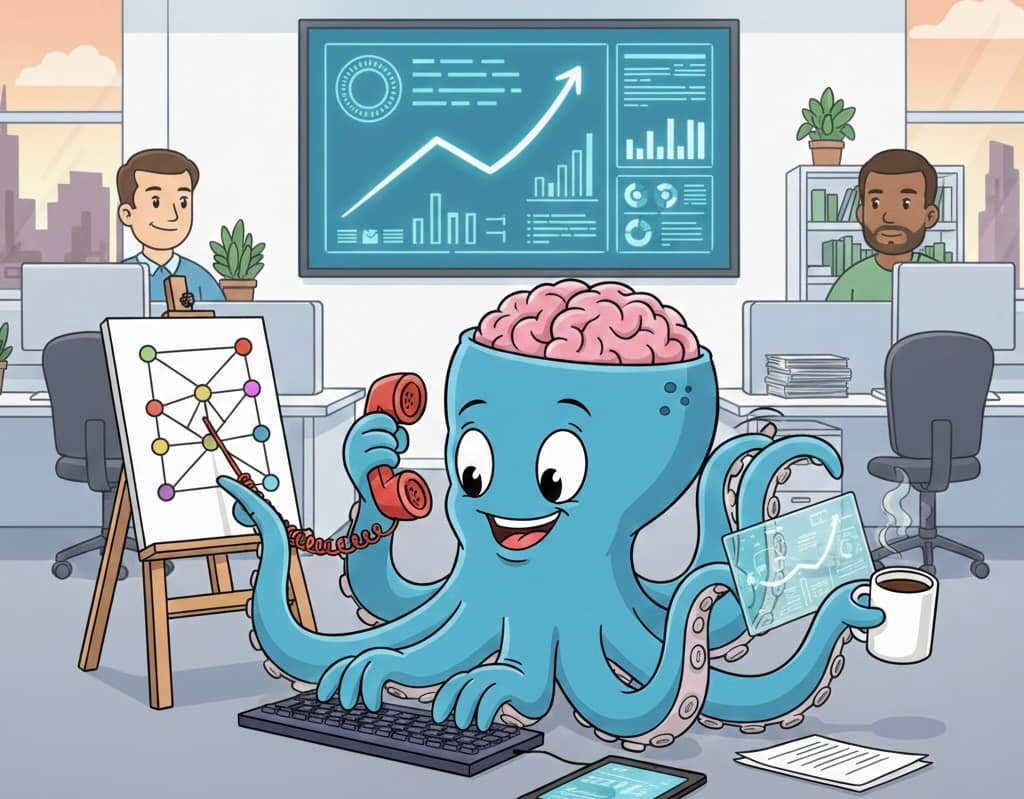
The octopus metaphor imagines an organization with many autonomous tentacles—cross-functional teams, alliance networks, and partner ecosystems—that can reach out, sense changes in the environment, and act without waiting for a centralized “green light.”
The central brain remains essential: it coordinates sensemaking, aligns purpose, and protects the system from misdirection. The strength of this model is not chaos; it’s deliberate decentralization guided by shared intent, transparent information flows, and rapid, safe experimentation.
Complex vs. Complicated: Two Kinds of Organizational Trouble
A helpful way to frame organizational design is to distinguish between two systems that are often confused:
- Complicated systems have many parts, but their behavior is predictable with the right knowledge. They reward deep expertise and careful planning. Think of a well-engineered production line; if you have the blueprint and the specialists, outcomes can be forecast and controlled.
- Complex systems are characterized by emergent behavior. Interactions among people, technology, and markets create feedback loops that produce outcomes you cannot predict in advance. Small changes can cascade in surprising ways.
Understanding this distinction matters because political dynamics follow the system’s logic. Complicated organizations solve problems with expert-driven planning; complex organizations solve them through adaptable networks and constant learning loops.
How Internal Politics Differ
The “power play” inside your office depends entirely on which system you are operating in:
- In Complicated Organizations: Politics centers on who has the right model, the right expertise, and access to scarce resources. Authority is tied to specialized knowledge. Political energy goes into managing resource allocation and protecting project pipelines.
- In Complex Organizations: Politics is about trust, relationships, and collective sensemaking. Power shifts along networks of influence rather than formal titles. The challenge is not simply “who decides,” but how quickly diverse actors can interpret signals and align on a common purpose.
Concrete Contrasts at a Glance
| Feature | Complicated Org | Complex (Octopus) Org |
| Where Conflict Arises | Process ownership & gatekeeping. | Interpretive frames & signal reading. |
| Decision Making | Expert-led, formal milestones. | Distributed rights; fast feedback. |
| Success Metrics | Efficiency & Standardization. | Learning velocity & Network health. |
| Risk Management | Control, checklists, & compliance. | Resilience & Capacity to absorb shocks. |
From Concept to Practice: How to Shift
If you’re aiming to cultivate an octopus-like operating model, focus on these practical moves:
- Rewire Governance for Distributed Sensemaking: Create a central nervous system that processes signals from all tentacles without becoming a bottleneck.
- Empower Tentacles with Guardrails: Give teams explicit decision rights for their domains. Replace micromanagement with transparent interfaces.
- Invest in Boundary-Spanning Roles: Hire “translators” who can join up different tentacles into coherent action.
- Design Safe-to-Fail Experiments: Encourage small, reversible tests to learn quickly without risking the whole system.
- Cultivate Psychological Safety: Leaders must model humility and reward knowledge sharing over political maneuvering.
A Note of Caution
Moving toward an octopus organization isn’t a guarantee of harmony. The risk is misalignment within the nervous system: if the brain and tentacles drift apart, the system becomes tangled rather than agile. Leadership must stay committed to purpose and be willing to reconfigure the network as the environment evolves.
Putting it All Together
The Octopus framework offers a compelling lens to analyze why some organizations feel brittle and others feel alive. Complex organizations win by learning faster and making sense together.
Start by mapping your current structure: where are your tentacles, where is your central nervous system, and where are the gaps in sensemaking? The result isn’t chaos; it’s a living, breathing organism capable of catching the next signal and turning it into action.
References & Further Reading
- Le-Brun, P., & Werner, J. (2025). The Octopus Organization: A Guide to Thriving in a World of Continuous Transformation. Harvard Business Review Press.
- Werner, J., & Le-Brun, P. (2025). “Become an Octopus Organization.” Harvard Business Review Magazine.
- Snowden, D. J., & Boone, M. E. (2007). “A Leader’s Framework for Decision Making.” Harvard Business Review.
- Edmondson, A. C. (2018). The Fearless Organization. Wiley.
- McChrystal, S., et al. (2015). Team of Teams. Portfolio/Penguin.