How AI Code Generation Is Commodifying Software — And Why That Should Terrify You
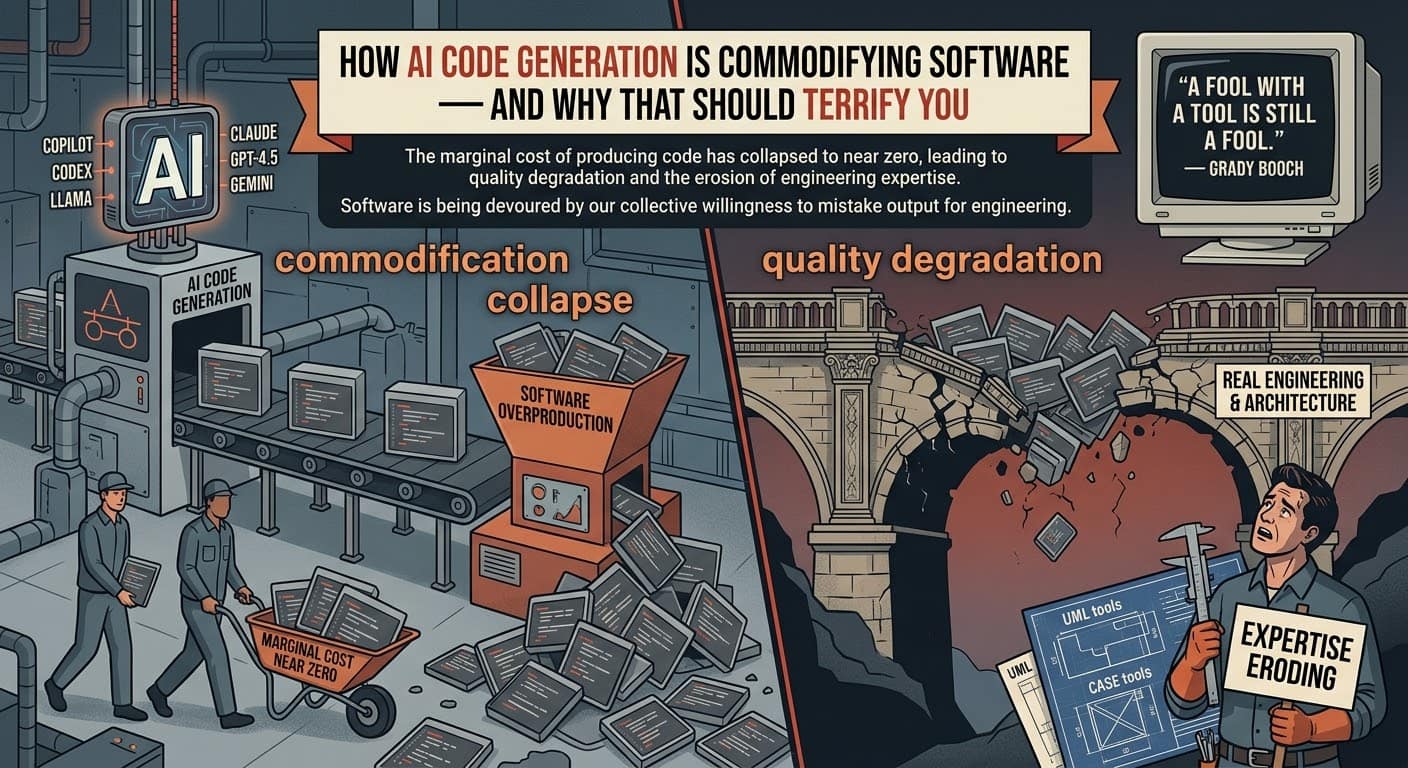
“A fool with a tool is still a fool.” — Grady Booch
Grady Booch said this decades before anyone had a copilot in their IDE. He was talking about CASE tools, UML generators, the object-oriented revolution — the last time the industry convinced itself that tooling would obviate the need for thinking. It didn’t. And here we are again.
From Copilot to Codex, Llama to Claude, GPT-4.5 to Gemini — any developer can now paste a prompt and get a working function, a module, or a full application skeleton in seconds. The marginal cost of producing code has collapsed to near zero. And like every commodity collapse in economic history, the consequences are playing out on schedule: overproduction, quality degradation, and the slow erosion of the expertise that made the product valuable in the first place.
Software is being devoured. Not by AI itself, but by our collective willingness to mistake output for engineering.
The Commodification Arc
Every industry that undergoes commodification follows the same three-act structure. Software is no exception.
Act I — Craft. Writing code was an art. Repositories were unique. Developers were celebrated for craftsmanship — elegant algorithms, tight loops, systems that ran lean. The profession carried a culture: rubber duck debugging, holy wars over tabs vs. spaces, the ritual of the code review. These weren’t affectations. They were the byproducts of a discipline that demanded deep engagement with the material.
Act II — Industrialization. Writing code becomes a task. Repositories become template-driven. The celebration shifts from craft to velocity — sprint velocity, deployment frequency, time-to-market. AI-augmented IDEs, low-code platforms, and code-generation SaaS flood the market. Code becomes something you can procure, not just produce.
Act III — Commodity. Writing code becomes a service. Repositories are AI-generated. The celebration shifts again, this time to automation itself. The product — the app, the bot, the microservice — becomes the status symbol, severed entirely from the process that created it. Nobody asks how the code was written. They ask how fast.
We are deep into Act II and accelerating toward Act III. The question isn’t whether we’ll get there. The question is what we lose when we arrive.
What We Lose
Design Drift
When code is cheap, architecture gets sloppy. The mental gymnastics of hand-coding forced developers to think about structure — because mistakes were expensive. AI-generated code removes that friction, and with it, the forcing function for good design. “It works, let’s ship it” becomes the operating principle. Nobody notices the architectural debt until the system is three years old and unmaintainable.
This is the pattern I’ve seen play out repeatedly in enterprise environments: teams accept sub-optimal architectures because the AI gave them something functional in minutes. Functional is not the same as sound. A building that stands is not the same as a building that’s engineered.
Security Blind Spots
Generated code introduces vulnerabilities the same way a junior developer does — through ignorance of context. The model doesn’t know your threat model. It doesn’t know that the SQL query it just generated runs against a database containing PII. It doesn’t know that the API endpoint it exposed should require mutual TLS. If developers treat AI as a black box, they inherit every blind spot the training data encoded.
Skill Atrophy
This is the one that keeps me up at night. A generation of developers is entering the profession who may never learn the fundamentals — language semantics, data structures, algorithmic complexity, memory management. They’ll be productive. They’ll ship features. And they will be structurally incapable of debugging the systems they built when those systems fail in ways the AI never anticipated.
You cannot review what you don’t understand. And you cannot guide what you cannot evaluate.
Cultural Erosion
This one sounds soft until you realize what culture actually does. The stories, rituals, and shared language of software engineering aren’t nostalgia — they’re knowledge-transfer mechanisms. When “rubber duck debugging” disappears, what disappears with it is the practice of forcing yourself to articulate a problem clearly enough to solve it. When nobody writes tight loops anymore, nobody thinks in tight loops. The culture carried the craft. Without it, you’re left with output and no intuition.
Booch Was Right (And It’s Worse Than He Thought)
Let’s decompose the quote against the current landscape:
Tool = AI. Having a generative model in your IDE is powerful. It is not, by any definition, engineering. A table saw doesn’t make you a carpenter. A Bloomberg terminal doesn’t make you a trader. And Claude doesn’t make you an architect.
Skill = Insight. The irreducible core of software engineering has never been typing. It’s understanding why a piece of code works — or doesn’t. It’s recognizing that the O(n²) solution the AI handed you will crater in production. It’s knowing that the microservice boundary the model suggested violates your domain’s aggregate consistency requirements. That knowledge lives in the human, not the model.
Fool = Over-reliance. The developer who copies AI output without review isn’t augmented. They’re automated — and they’re the weakest link in the system. They propagate bugs, violate patterns, and build brittle architectures that look correct until they don’t.
The Booch equation used to be a warning about power tools. Now it’s a warning about the entire profession’s trajectory.
What Humans Must Do (That AI Cannot)
The division of labor between human and machine isn’t a temporary arrangement. It’s a permanent structural reality, and understanding it is the difference between being augmented and being replaced.
| Domain | What AI Does Well | What Requires Human Judgment |
|---|---|---|
| Correctness | Auto-completes syntax, generates working code | Verifies logic, identifies edge cases, validates business rules |
| Architecture | Suggests patterns from training data | Defines system boundaries, evaluates trade-offs, enforces domain invariants |
| Testing | Generates unit tests from function signatures | Designs integration tests, performance tests, chaos engineering scenarios |
| Security | Applies common libraries and boilerplate | Conducts threat modeling, code audits, supply-chain analysis |
| Maintainability | Uses default naming and structure | Enforces coding standards, writes documentation, manages technical debt |
Five Principles for the AI-Augmented Engineer
1. Prompt with intent, not commands. “Design a thread-safe cache for a high-concurrency payment processing system with LRU eviction and circuit-breaker fallback” will produce fundamentally different output than “Write me a cache.” The quality of AI output is a direct function of the domain knowledge encoded in the prompt. If you can’t write a precise prompt, you don’t understand the problem well enough to evaluate the solution.
2. Review before you commit — always. Adopt a review-first workflow. Run linters, static analyzers, and dependency scanners on every piece of generated code. Treat AI output with the same rigor you’d apply to a pull request from an engineer you’ve never worked with.
3. Invest in domain knowledge. AI can’t substitute deep understanding of the problem domain. The developer who understands ISO 20022 messaging semantics will write better prompts, catch more errors, and architect more resilient payment systems than the developer who only knows Python. Domain expertise is the new moat.
4. Teach the model your context. Use system prompts, fine-tuning, and prompt engineering to align the model with your architecture patterns, coding standards, and domain constraints. A model that understands your service mesh topology will produce better code than one operating in a vacuum.
5. Champion security as culture, not checklist. Run generated code through SAST, DAST, and SCA pipelines. But more importantly, maintain a culture where security is a design constraint, not an afterthought. AI doesn’t do threat modeling. You do.
The Road Ahead
The path forward isn’t rejection of AI. That ship sailed. The path forward is refusing to let the tool define the craft.
Celebrate velocity — but not at the expense of soundness. AI accelerates time-to-market and eliminates repetitive work. That’s genuinely valuable. It’s also genuinely dangerous if velocity becomes the only metric that matters.
Celebrate craftsmanship — because it’s rarer now, and therefore more valuable. The projects where human insight drives architectural brilliance, innovative algorithms, or transformative user experience will be the ones that differentiate. In a world of commodity code, craft is a competitive advantage.
Celebrate education — because the curriculum has to change. We need to teach engineers how to leverage AI, not how to depend on it. That means doubling down on fundamentals — distributed systems theory, security principles, domain-driven design — alongside prompt engineering and model evaluation.
Celebrate community — because shared standards are the antidote to commodity drift. Open-source architecture patterns, shared code review practices, and collaborative security frameworks are how the profession maintains quality when individual skill is no longer the bottleneck.
Final Thought
AI is here to enrich software engineering, not replace it. But enrichment requires intentionality. A tool — no matter how sophisticated — cannot replace judgment. It can amplify it. It can accelerate it. It can extend its reach. But it cannot create it from nothing.
The developers who thrive in this era will be the ones who understand what the machine does well, what it does poorly, and where the boundary between the two actually falls. They’ll use AI to automate the mundane while keeping the creative, analytical, and architectural heart of engineering alive.
Grady Booch’s warning hasn’t expired. If anything, the stakes are higher now than when he first said it. The tools are more powerful, the temptation to defer is stronger, and the consequences of foolishness are systemic rather than local.
Don’t be the fool.