The infrastructure industry has spent the last year converging on a new term: the agentic data plane. Redpanda productized it. IBM formalized the vocabulary. Analysts are drawing the diagrams. The idea is that AI agents cannot be trusted with operational systems until there is a governed execution layer between the agent and the data. This layer mediates access, assembles context, supervises actions, and records everything for replay and audit.
Here is the thing. If you strip the AI branding off that definition, you are describing a pattern that payments engineering solved years ago because payments never had the luxury of trusting any actor, human or machine, with direct access to money movement.
This post maps the emerging agentic data plane concept, capability by capability, onto the Payment Transaction Platform architecture documented across eighteen granted patents. Then it takes one decisioning problem, intelligent payment routing, and walks through what agentic decisioning looks like when it runs inside that substrate instead of on top of it.
What the industry means by an agentic data plane
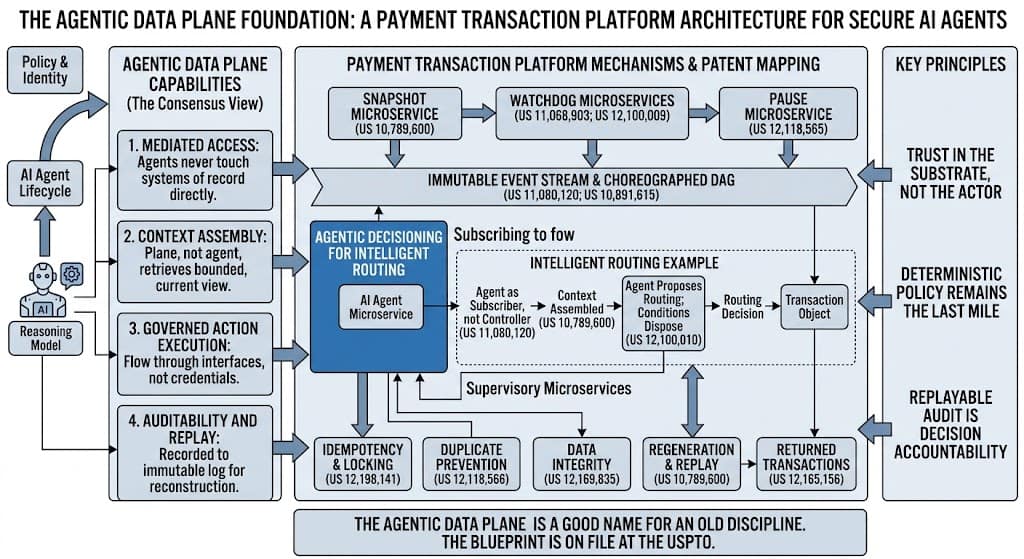
The vocabulary borrows the classic networking split. The control plane governs: it holds identity, policy, agent lifecycle, and the rules of engagement. The data plane executes: it is where an agent actually reads data, calls tools, and takes actions. The agentic data plane is the execution substrate, and the emerging consensus is that it must provide four things.
- Mediated access. Agents never touch systems of record directly. Every read and write passes through a gateway that enforces per-agent, per-task authorization, applies guardrails, and scopes permissions to the work at hand.
- Context assembly. The plane, not the agent, is responsible for retrieving a bounded, governed, current view of the world before the agent reasons over it. Agents that improvise their own retrieval improvise their own mistakes.
- Governed action execution. Actions flow through defined interfaces with explicit scopes, budgets, and preconditions, never through raw credentials.
- Auditability and replay. Every action is recorded into an immutable log with enough fidelity to reconstruct what the agent saw, what it decided, and why.
Reasonable requirements. Also familiar ones. Each of these four is a load-bearing property of the Transaction Exchange Platform, and each maps to specific patented mechanisms. The mapping is worth doing precisely because the ADP conversation is happening in the abstract, while payments already has the concrete answer sheet.
Payment Transaction Platform substrate, briefly
For readers new to the architecture: the Transaction Exchange Platform is a choreographed, event-driven system in which a transaction is represented as a transaction object flowing through a directed acyclic graph of microservices. There is no central orchestrator issuing commands. Each microservice subscribes to streaming transaction data, evaluates whether the object meets its conditions for processing, does its work, and emits the result back onto the stream.
The processing rules themselves are configuration, not code: which services act, in what circumstances, under what conditions, is defined declaratively and can change without redeployment.
Around that core sits a supervisory and integrity apparatus. Watchdog microservices detect stalled or failed processing and intervene. Locks that would otherwise deadlock a failed workflow get resolved. Idempotency is enforced through consensus key locking with fast local storage. Duplicate transactions are detected and removed before they move money twice. A pause microservice can halt a workflow class mid-flight.
Snapshot and regeneration services can reconstruct a transaction object’s state at any point and replay it. Data integrity microservices validate that no object was tampered with in transit, and returned transactions get first-class handling rather than exception-queue purgatory.
None of this was designed for AI agents. It was designed for a harder constraint: software that moves trillions of dollars cannot assume any component is trustworthy, correct, or alive. That constraint turns out to be a superset of the agentic one.
The blueprint: ADP capability to PTP mechanism
| Agentic data plane capability | Payment Transaction Platfrom mechanism | Patent grounding |
|---|---|---|
| Mediated access; agents never touch systems of record | All interaction occurs through the event stream; no service, agent or otherwise, holds direct credentials to another’s state | US 11,080,120; US 10,891,615 |
| Policy as configuration, enforced at the boundary | Declarative conditions define which services process which objects under which circumstances | US 12,100,010; US 11,023,528; US 12,141,205 |
| Context assembly; bounded, current state delivered to the decision maker | Snapshot microservice materializes authoritative transaction state on demand | US 10,789,600 |
| Supervision of autonomous actors | Watchdog microservices detect stalls, failures, and lock contention, then remediate | US 11,068,903; US 12,100,009; US 12,223,508; US 12,198,142 |
| Idempotent action execution | Consensus key locking guarantees an action lands exactly once | US 12,198,141 |
| Duplicate and runaway-action prevention | Dedicated detection and removal of duplicate transaction objects | US 12,118,566; US 12,118,567 |
| Kill switch and human-in-the-loop escalation | Pause microservice halts workflows mid-flight without data loss | US 12,118,565 |
| Replayable audit; reconstruct what was seen and decided | Immutable event stream plus object regeneration and replay | US 12,198,143; US 10,789,600 |
| Integrity of context; agents reason over untampered data | Data integrity microservices validate transaction object integrity | US 12,169,835 |
| Compensating actions when the world pushes back | First-class returned-transaction handling | US 12,165,156 |
The mapping is not a coincidence and it is not marketing. Both architectures answer the same question: how do you let autonomous components act on high-stakes state without trusting any of them individually?
The event-driven choreography answer is that trust lives in the substrate, in the stream, the conditions, the watchdogs, and the replay log, rather than in the actors. An agentic data plane is that answer restated for a world where the actor is a language model instead of a microservice.
Deep dive: agentic decisioning for intelligent payment routing
Routing is the right problem to examine because it is genuinely a decision, not a lookup. A payment leaving a platform today can travel over ACH, same-day ACH, RTP, FedNow, Fedwire, or in some cases a book transfer or a partner network. The optimal choice depends on amount and network limits, cost per rail, the receiving institution’s rail participation, cutoff windows and settlement timing, the sender’s urgency and tolerance for cost, current rail health, fraud posture on the counterparty, and liquidity position at the moment of release.
Most platforms encode this as a static decision table that a committee updates quarterly. The table is stale the day it ships.
This is where agentic decisioning earns its keep. A routing agent can reason over the live tradeoff space: FedNow is up but this receiving RTN does not participate; RTP is available but the amount exceeds the limit; same-day ACH makes the cutoff with eleven minutes of margin and saves forty dollars against the wire; the counterparty has two returns in ninety days, which shifts the risk calculus. That is judgment work, and it is exactly the kind of judgment work a reasoning model does well when it is given accurate context and bounded authority.
This is where agentic decisioning earns its keep. A routing agent can reason over the live tradeoff space: FedNow is up but this receiving RTN does not participate; RTP is available but the amount exceeds the limit; same-day ACH makes the cutoff with eleven minutes of margin and saves forty dollars against the wire; the counterparty has two returns in ninety days, which shifts the risk calculus.
That is judgment work, and it is exactly the kind of judgment work a reasoning model does well when it is given accurate context and bounded authority.
1. The agent is a subscriber, not a controller
The routing agent joins the DAG the way any microservice does. It subscribes to transaction objects that match its conditions: payment initiated, routing not yet assigned, amount and product within the agent’s chartered scope. It holds no database credentials, no API keys to the rails, no ability to reach around the stream. Its entire interface to the world is consuming objects that policy says it may see and emitting proposals that policy says it may make. Mediated access is not a wrapper added for the agent’s benefit; it is the only mode of participation the architecture offers anyone.
2. Context is assembled for the agent, not by it
Before the agent reasons, the substrate composes its working context: the current transaction object, a snapshot of authoritative state, rail health and cutoff telemetry from the event stream, and counterparty history scoped to what routing policy permits it to consider. The agent does not go fishing across systems of record, which is where both hallucinated context and data exfiltration are born. Integrity validation on the object means the agent is reasoning over state that is provably untampered. If the context is wrong, that is a substrate defect with a single owner, not a mystery distributed across every prompt the agent ever improvised.
3. The agent proposes; conditions dispose
The agent’s output is not a routed payment. It is a routing decision written onto the transaction object: chosen rail, alternates, and a machine-readable rationale. Downstream, the same declarative condition machinery that governs every service evaluates the proposal.
Amount within rail limit. Rail participation confirmed. Cost within the product’s tolerance. Decision consistent with sanctions and fraud posture. A proposal that violates a condition never executes, no matter how confident the model was.
4. Supervision assumes the agent will fail
Language models stall, time out, and occasionally return nonsense. The watchdog apparatus treats an unresponsive routing agent identically to an unresponsive microservice: detect the stall, resolve any locks it was holding, and either regenerate the transaction object for retry or route the object down a deterministic fallback path.
The consensus key lock guarantees that a retried decision cannot double-route a payment, and duplicate detection catches the case where an agent, retried at the application layer, emits the same proposal twice. The failure modes of agents are new in flavor but not in category, and the category was already engineered for.
5. Escalation and the kill switch are architectural
When the agent’s confidence is low, when the proposal sits near a policy boundary, or when conditions flag an anomaly, the transaction object routes to a human review queue as an ordinary workflow branch.
And if the agent misbehaves at the population level, drifting after a model update, say, the pause microservice halts the routing workflow class in place, mid-flight, without losing a single object. Payments in progress hold their state; humans or a fallback table take over; the resume is clean.
6. Every decision is replayable
Because the agent’s context was assembled by the substrate and its proposal was written to the stream, the platform can reconstruct, months later, exactly what the agent saw and what it decided, then replay the decision against the regenerated object.
When the OCC examiner asks why a four million dollar payment went Fedwire instead of RTP on March 3rd, the answer is not a shrug about model internals. It is a snapshot, a rationale, a condition evaluation trace, and a replay. Model explainability remains an open research problem; decision accountability does not have to wait for it.
Why this matters beyond payments
The general lesson runs in the opposite direction from most agentic architecture advice. The industry instinct is to start with the agent and ask what guardrails to add. The payments lesson is to start with a substrate that never trusted its actors and ask what a reasoning actor adds.
Under that framing, the agent is just the most capable microservice yet admitted to the DAG, and the questions that stall enterprise agent deployments, about permissions, supervision, idempotency, rollback, and audit, were answered before the agent arrived.
There is also a sharper claim underneath. Money movement is the adversarial, irreversible, regulated worst case of agentic action. An architecture proven there is not a niche solution; it is an existence proof for the whole category. Teams building agentic data planes for supply chains, claims processing, or trading operations will rediscover the watchdog, the pause service, the consensus lock, and the replayable snapshot, because those are not payments features. They are what autonomy costs in any domain where actions bind the real world.
The agentic data plane is a good name for an old discipline. Payments got there first because it had to. The blueprint is on file at the USPTO.