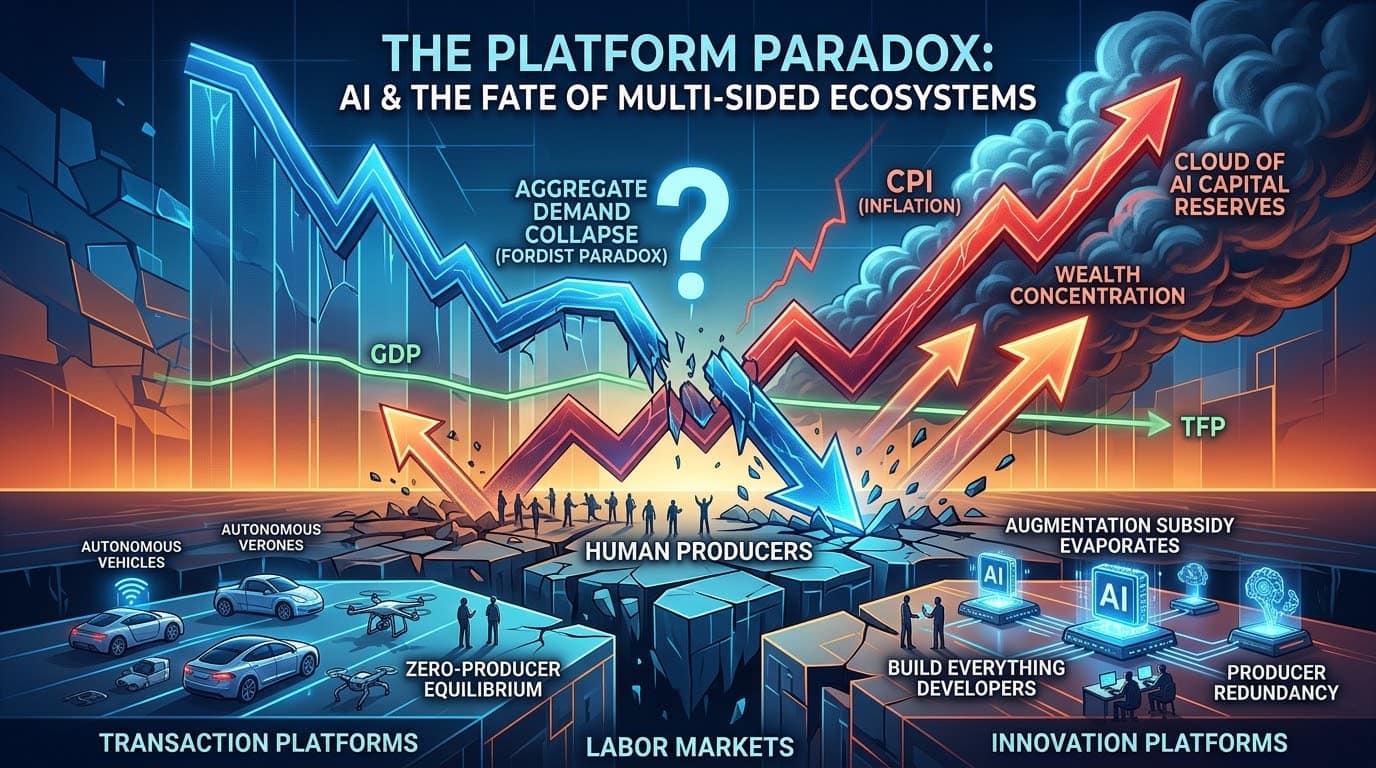
This post investigates the existential macroeconomic divergence facing the multi-sided platform model in the era of Generative Artificial Intelligence (GenAI). Historically, platforms have acted as “efficiency engines,” reducing transaction costs and subsidizing innovation for human producers. However, the emergence of AI as a primary agent of production forces a structural reckoning that plays out differently across the two dominant platform architectures: Transaction Platforms and Innovation Platforms.
We analyze this divergence through the lens of the Labor Share of National Income and the Fordist Paradox, arguing that while AI-driven substitution maximizes short-term microeconomic producer surplus, it risks a catastrophic contraction in aggregate demand. We propose a model of “Augmented Equilibrium,” where platforms utilize AI to trigger the Reinstatement Effect effectively lowering the skill floor to expand the production possibility frontier while maintaining the capitalization of human agents.
I. Theoretical Foundations: The Dual Nature of Platforms
To quantify the impact of AI on the platform economy, we must first define the structural mechanics of the ecosystem through rigorous economic frameworks. Platforms are not merely digital marketplaces; they are private institutional frameworks that internalize externalities and manage transaction costs. Critically, not all platforms do this in the same way, and that structural difference becomes the fault line along which AI disruption divides.
1.1 The Coasean Firm and Platform Internalization
Rooted in Ronald Coase’s The Nature of the Firm (1937), platforms exist where the cost of market-based coordination exceeds the cost of platform-based orchestration. AI dramatically lowers the marginal cost of orchestration, allowing platforms to expand their scope into previously unorganized “long-tail” sectors.
This expansion is governed by the Rochet-Tirole Model (2003) of multi-sided markets, where cross-side network effects are subsidized to reach critical mass. However, the mechanism by which each platform type achieves that critical mass and the role human producers play in sustaining it differs fundamentally.
1.2 Transaction Platforms vs. Innovation Platforms: A Structural Distinction
The failure to distinguish between the two dominant architectural models leads to category errors in both strategy and policy.
- Transaction Platforms (Connectors): Create value by reducing search and matching friction between existing buyers and sellers. Their unit economics are governed by throughput, the velocity and volume of exchanges (e.g., Uber, eBay, Airbnb). The platform does not augment what participants produce; it optimizes how they find each other. The human producer is essential not as a creator, but as a supply-side participant (the driver, the seller, the host).
- Innovation Platforms (Enablers): Create value by subsidizing the fixed costs of production itself via APIs, SDKs, distribution infrastructure, and data feedback loops (e.g., Apple’s App Store, Salesforce’s AppExchange, AWS). Here, the platform shifts the producer’s supply curve rightward by absorbing R&D overhead. The human producer is essential as a value creator (the developer, the designer, the domain expert).
The GenAI Reality: AI threatens Transaction Platforms modestly at the matching layer (where friction was already low). It threatens Innovation Platforms existentially: when the platform itself can produce the vertical applications it once subsidized producers to build, the producer class becomes redundant by design.
II. The AI Shock: Asymmetric Disruption Across Platform Architectures
The introduction of GenAI represents a supply-side shock, but its impact is not uniform. The Acemoglu-Restrepo (2019) Framework of Displacement and Reinstatement plays out asymmetrically depending on platform type. Conflating the two produces dangerously incomplete strategic conclusions.
2.1 The Displacement Effect on Transaction Platforms
For Transaction Platforms, AI’s displacement threat is real but structurally bounded. Matching algorithms already minimized human friction in routing buyers to sellers. What AI does threaten here is the producer supply side, the human who drives the car, writes the listing, or fulfills the order.
When AI can generate the supply directly (autonomous vehicles, AI-written content, automated fulfillment), the Transaction Platform no longer needs a producer class at all. This results in a Zero-Producer Equilibrium, where a platform owns both the demand aggregation layer and the AI-generated supply.
- Microeconomically: This is optimal; the take rate approaches 100%.
- Macroeconomically: It is catastrophic; the producer class that funded consumption on the demand side has been eliminated. The platform optimizes itself into a demand vacuum.
2.2 The Displacement Effect on Innovation Platforms
The threat to Innovation Platforms is more immediate and severe. These platforms historically created value by giving producers the tools to build, and then capturing a share of what those producers generated. GenAI inverts this entirely.
When the platform can generate applications, content, workflows, and integrations autonomously, the human producer is no longer the mechanism of value creation. They become optional commentary on a process the platform now owns end-to-end. The Augmentation Subsidy; the economic rationale for keeping human producers capitalized simply evaporates.
2.3 The Reinstatement Path: Architectural Levers
The Reinstatement Effect, deploying AI to create new complex tasks for humans rather than eliminating existing ones, requires platform-specific strategies.
- For Transaction Platforms: Reinstatement means elevating the human role above the commoditized transaction layer. The driver becomes a concierge; the seller becomes a curator. The task is no longer routing, but judgment, trust, and contextual intelligence. The platform’s obligation is to architect these higher-order roles deliberately.
- For Innovation Platforms: Reinstatement means redefining what it means to be a producer. If AI handles execution, the scarce human contribution shifts to Vision, Taste, and Domain Authority, the capacity to direct AI toward problems worth solving. The platform must lower the skill floor (allowing non-technical producers to direct AI-driven creation) while raising the ceiling on what those producers can achieve.
2.4 The Strategic Inflection Point
The platform architectures that survive the GenAI era will be those that recognize the substitution path as a short-term margin optimization with long-term demand destruction baked in. The question is not whether AI can replace producers, it demonstrably can. The question is whether platform architects recognize that a platform without producers is no longer a platform.
III. Economic Indicators: Quantifying the Paradox
Platforms must monitor four critical economic indicators to avoid ecosystem collapse.
3.1 The Erosion of the Labor Share of Income
Since the 1980s, the labor share of income in advanced economies has steadily declined, a trend GenAI is poised to accelerate.
- On Transaction Platforms: Erosion occurs at the supply layer as autonomous systems displace physical/creative labor.
- On Innovation Platforms: Erosion occurs at the creation layer as AI-generated code and content displace independent developers.
If platforms capture 100% of the value created by AI, they exacerbate wealth concentration. An ecosystem with a Gini coefficient approaching 1.0 is unsustainable; it lacks the broad-based income required to fuel consumption across the demand side of the marketplace.
3.2 Total Factor Productivity (TFP) vs. The Solow Paradox
The Solow Computer Paradox (1987) noted that “you can see the computer age everywhere but in the productivity statistics.” AI threatens a new version of this: high micro-efficiency but stagnant TFP if the technology is used merely for rent extraction rather than genuine innovation.
Platforms must ensure AI leads to TFP growth by enabling producers to create entirely new categories of value, rather than merely generating cheaper, automated versions of existing ones.
3.3 The Velocity of Money and Aggregate Demand
In Keynesian terms:
AD = C + I + G + (X – M)
If the producer class is substituted out, Consumption (C) suffers a systemic shock. The velocity of money within the platform ecosystem, the rate at which currency circulates from consumers to producers and back stagnates when capital is locked in the platform’s treasury rather than distributed through producer earnings.
Gig economy workers are disproportionately also platform consumers; removing their income instantly deletes local demand.
3.4 The Fordist Paradox and Marginal Propensity to Consume
The Fordist Paradox posits that workers must be capitalized to be consumers. Economically, human producers have a higher Marginal Propensity to Consume (MPC) than corporate treasuries. When a platform shifts income from a million human producers to its own capital reserves, it removes liquidity from the market, leading to deflationary pressure and eventual ecosystem stagnation.
IV. Speculative Futures: Governance and Micro-Ecosystems
4.1 Hyper-Niche Innovation Platforms and Vertical Depth
As general-purpose AI matures, economic value shifts to deep contextual data. We predict the emergence of specialized Innovation Platforms that own Vertical Knowledge Moats (e.g., precision medicine, quantum engineering, climate modeling) where the cost of error is high and human domain expertise is irreplaceable.
These platforms will be highly defensible due to the Specificity of Complementary Assets (Teece, 1986). Transaction Platforms, by contrast, face consolidation toward monopoly/oligopoly as the long tail of human suppliers collapses into a small number of AI-managed supply pools owned by the platform itself.
4.2 Agent-to-Agent (A2A) Economies and Algorithmic Friction
The transition to A2A economies will eliminate human-centric transaction costs but introduce new Algorithmic Externalities.
- On Transaction Platforms: Agent-managed logistics risk collusive equilibria that harm consumers.
- On Innovation Platforms: Agent-generated software risks homogenization. a landscape of technically competent but contextually hollow products.
Platforms will need to transition from traditional antitrust frameworks to Computational Antitrust to regulate non-human economic actors.
V. Strategic Imperative: Designing for Augmented Equilibrium
Platform architects must adopt a Social Contract of Augmentation, shifting structurally from Extraction-Based Models to Contribution-Based Models.
For Transaction Platforms
- Elevate the Human Role: Design for trust, judgment, and relational intelligence as the defensible layer above commoditized AI supply.
- Reinvest Efficiency Gains: Pass AI-driven cost reductions back to producers via capability investments, tools, and training rather than capturing it all as pure margin.
- Track Producer Capitalization: Adopt producer income stability and consumer capacity as leading KPIs of platform health.
For Innovation Platforms
- Low-Floor, High-Ceiling Infrastructure: Build tools that allow non-technical producers to enter easily via AI assisted-creation (Low Floor) while allowing domain experts to achieve exponential scale (High Ceiling).
- Pre-Distribution of Value: Ensure the primary distribution of income remains heavily tilted toward human agents providing the irreplaceable Vision and Curation.
- Cultivate Vertical Knowledge Partnerships: Treat specialized producer communities as your core moat against generalist AI commoditization.
VI. Conclusion
The Platform Paradox represents the final evolution of the capital-labor conflict. Transaction Platforms risk optimizing their supply side into a Zero-Producer Equilibrium, hollowing out the very consumer base that sustains demand. Innovation Platforms risk internalizing the creative function entirely, defunding the producer ecosystem that once served as both their R&D engine and their most loyal market.
In both cases, total substitution achieves a hyper-efficient, yet ultimately empty, marketplace. The most resilient platforms will be those that use AI to reinstate human agency rather than retire it. Not out of altruism, but out of economic self-preservation. Optimize human participants out, and you have not built a more efficient platform but instead, scheduled its obituary.
Bibliography
- Acemoglu, D., & Restrepo, P. (2019). Automation and New Tasks: How Technology Displaces and Reinstates Labor. Journal of Economic Perspectives, 33(2), 3–30.
- Coase, R. H. (1937). The Nature of the Firm. Economica, 4(16), 386–405.
- Cusumano, M. A., Gawer, A., & Yoffie, D. B. (2019). The Business of Platforms: Strategy in the Age of Digital Competition, Innovation, and AI. Harper Business.
- Keynes, J. M. (1936). The General Theory of Employment, Interest, and Money. Palgrave Macmillan.
- Rochet, J. C., & Tirole, J. (2003). Platform Competition in Two-Sided Markets. Journal of the European Economic Association, 1(4), 990–1029.
- Solow, R. M. (1987). We’d Better Watch Out. New York Times Book Review.
- Teece, D. J. (1986). Profiting from Technological Innovation: Implications for Integration, Collaboration, Licensing and Public Policy. Research Policy, 15(6), 285–305.