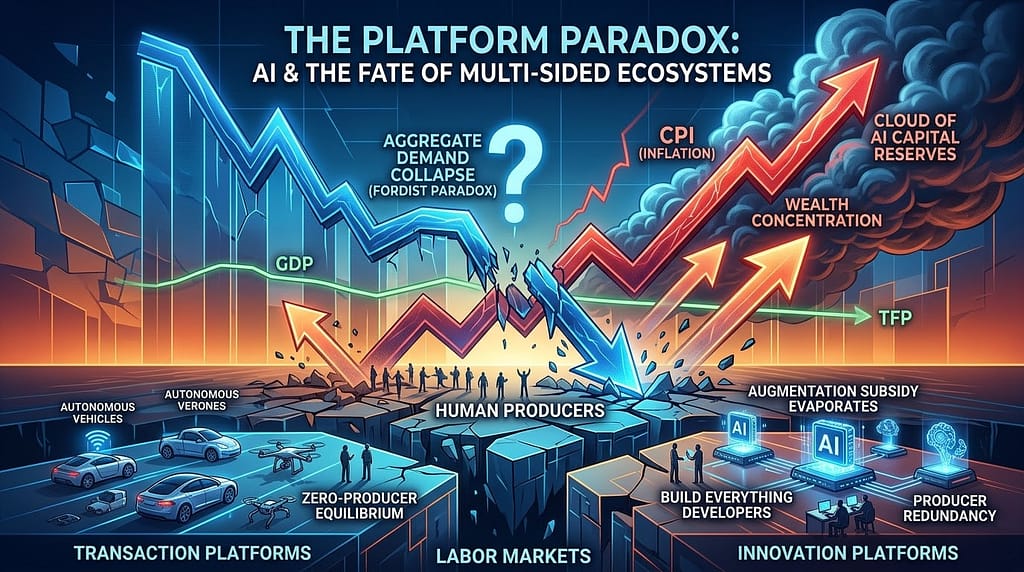
The Paradox of Progress: AI’s Wild Profits Could Collapse Capitalism

Metric Traditional Bank (ie. JPM Chase) Autonomous Enterprise (ie. WeBank) Supporting Evidence
Employees per Million Customers ~1,100 to 1,500 (Estimates for traditional banks) ~8 (Based on 2019 data of ~100M customers and ~800 staff) WeBank’s Cost-to-Income Ratio (CIR) is consistently reported between 25% and 35%, far below the 55% to 65% average for major U.S. banks. This ultra-low CIR is the clearest financial evidence that cost centers (like employees and branches) have been eliminated, directly leading to high NIPE.
Cost Per Loan $4.00 – $20.00+ (for traditional SME lending) ~$0.40 (for MyBank’s micro-SME loans) MyBank, similar to WeBank, uses proprietary AI risk models to automate credit decisions, drastically reducing human underwriting costs and validating the claim that technology drives unparalleled operational efficiency.
Occupancy Cost $ Billions annually (for branch networks) $0 The complete elimination of fixed overhead from physical branches is the single largest structural advantage validating the low-cost/high-profit argument.
Economic Data Quantitative Evidence Link to the Paradox
Productivity vs. Wages Since 1979, U.S. worker productivity has risen by ~70%, while the average hourly compensation for production/non-supervisory workers has risen by only ~15%. The “Cannibalization” has already begun. Companies are capturing the majority of value generated by efficiency gains (technology) as profit, rather than distributing it as higher wages (disposable income). This creates the consumption gap the blog post addresses.
Labor Share of Income The share of national income going to labor (wages and benefits) has declined steadily from its peak, while the share going to capital (profits, dividends, interest) has risen. The profit-maximizing incentive has already shifted value from the many (consumers/employees) to the few (shareholders/owners), validating the argument that profits are being prioritized over market health.
Job Polarization Studies show rapid growth in both high-skill/high-wage jobs (which AI creates) and low-skill/low-wage service jobs (which cannot be automated), with a hollowing out of the middle-wage/middle-skill roles (the traditional consumer backbone). This polarization limits the number of high-income consumers, leaving the vast majority of people with insufficient disposable income to purchase the high-volume goods and services produced by the automated economy.
Policy/Trend Quantitative Evidence Link to the Argument
UBI Funding Proposals (VAT) Economists propose a Value-Added Tax (VAT) rate of 10% coupled with UBI, which analysis shows would increase after-tax income for the lowest 20% of households by ~$17%. The VAT is the mechanism for recycling profit back into the consumer base. This model transforms a typically regressive tax into a progressive system when coupled with UBI, ensuring market health.
“Robot Tax” Proposals Proposals, including those from Bill Gates, advocate for a payroll-equivalent tax on automation (or a progressive levy on profit gains from AI) to replace the lost revenue stream from human wages. The tax directly targets the efficiency gains from automation. Losing a human worker means losing payroll tax revenue; a robot tax ensures automation contributes to the social safety net it disrupts.
Corporate Tax Avoidance Over a five-year period (2018-2022), 342 profitable U.S. corporations paid an average effective federal tax rate of 14.1%, significantly lower than the statutory rate of 21%. This evidence supports the “Power Imbalance” claim: Corporations are already lobbying to shrink the tax base through loopholes (profit shifting to tax havens) while simultaneously relying on a healthy consumer market sustained by public funds.

How to Fund It:

  • Corporate Income Tax: Grab a chunk of AI profits.
  • Value-Added Tax (VAT): Tax goods and services efficiently.
  • Wealth & Land Taxes: Capture passive value generated without labor.
Views: 31